
The Playbook for Answer Engine Optimization

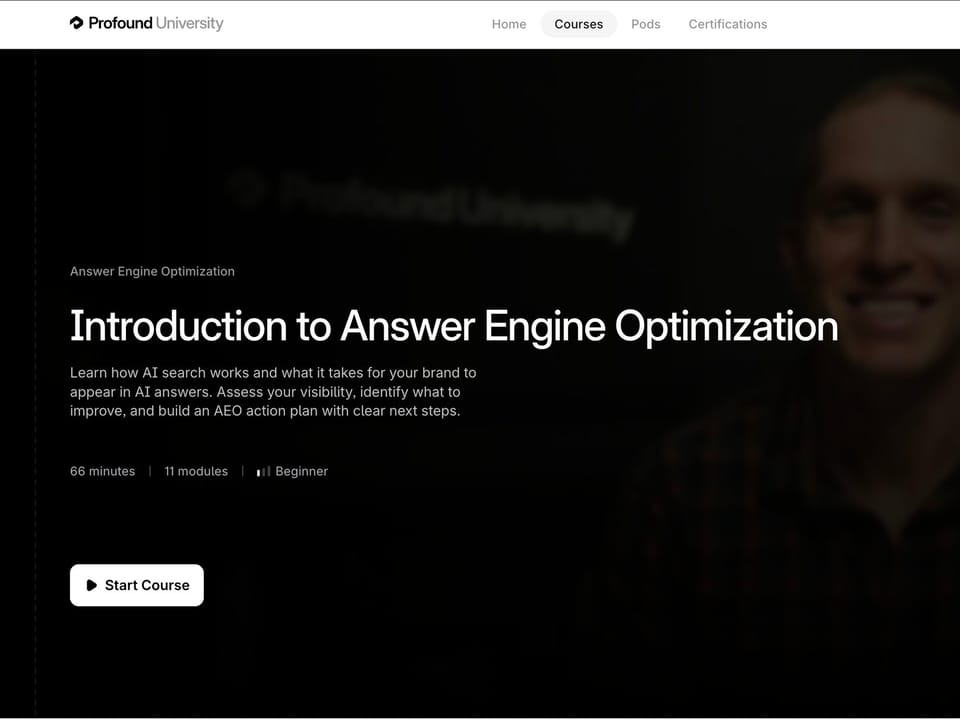
I just took a 66-minute, 11-module AEO course. Here's the complete list of notes and my biggest takeaways.
The Click Is Dying Faster Than You Think
68% of US Google searches ended without a click in early 2026, up 60% from 2024. And it gets worse. In Profound's study of 221 shopping tasks in ChatGPT, 92.8% ended without a meaningful click to any website. Whatever the model says about you stands as fact.
AEO doesn't replace SEO. Here's how to think about it: SEO earns you a spot in the list. AEO earns you a spot in the answer.
What AEO Actually Looks Like in Practice
On your site: put the direct answer first, write paragraphs that stand on their own, and add schema markup.
Off your site: review sites, comparison articles, Reddit threads and trade press drive far more of your AI visibility than your website does.
Associations Versus Attributes
Associations are what AI says about you today. Attributes are what you want it to say. AEO is closing the gap between the two.
Profound's FactCheck flagged 7.9% of AI answers about WHOOP as wrong. That's about 1 in 12. The question isn't whether AI knows about you. It's whether what it knows is accurate.
How to Prove It Works When Nobody Clicks
When AI brings up a brand the user didn't mention, that brand gets up to 1.5–2.5x the site visits over the next 7 days. But 97%+ show up with no referral tag. People read the answer, open a new tab, and type your name in.
The click is not the goal. The mention is.
Find Your Real Problem First
Missing from the broad answer? That's an authority problem. The fix is volume and consistency. Kiteworks published 8x more per day for 5 months and passed Microsoft, Box and Dropbox at 48% visibility.
Missing from the specific answer? That's a relevance problem. The fix is specificity: cover every qualifier and publish comparison pages.
How Answer Engines Actually Work
Check your robots.txt. A blanket block from 2023 can quietly keep you out of ChatGPT's live answers.
The engine turns one prompt into multiple background searches. You can't target an exact phrase. Target the topic instead.
AI learns your brand from your docs, help center, reviews, PR and community threads. Most of that isn't owned by marketing.
The SAGE Playbook
Profound calls their framework SAGE:
- Setup: Decide what you want AI to say, which buyers and questions you're tracking, and set a baseline.
- Analyze: Where you're missing, where you're described wrong, who shows up instead. End with a short ranked list.
- Generate: Publish or fix the content and earn third-party mentions. Then check the answers again, because shipping a page doesn't mean the gap is closed.
- Engineer: Turn the repeat work into agents. Plaid's two-person team built content, FAQ and reporting agents. A 300-prompt project took them under 2 hours instead of 2 weeks.
This last point matters. As teams figure out how to compress weeks of work into hours, the competitive gap between companies doing AEO and those ignoring it will only widen.
Stop Asking If AI Knows You
The line I keep coming back to: Stop asking whether AI knows about you, and start asking whether it can reach you when it goes looking.
When half of marketing teams will be rewriting their AI messaging in the next year, getting ahead of this shift isn't optional. The brands that show up in AI answers today are building moats that will be hard to cross tomorrow.
Start the Profound University course to build your own AEO strategy.